Is AI Making Your Electric Bill Higher? What’s Actually Happening in 2026


If your electricity bill has been creeping up over the past year or two, you’re not imagining it. And depending on where you live, AI data centers might be a significant part of why.
This isn’t speculation anymore. NPR profiled a retired couple in Granville, Ohio, Ken and Carol Apacki, who’ve tracked every charge on their electric bills for five years. Their rate went from 11 to 12 cents per kilowatt hour in 2020 to 19 cents in 2025. That’s a 60% increase. Carol points to the 130+ data centers in Central Ohio as a likely contributor. She’s not wrong, though the full picture is more complicated than “AI did it.”
The truth is somewhere between “AI is destroying the power grid” and “your bill has nothing to do with data centers.” Both narratives are floating around right now, and both are incomplete. Here’s what’s actually happening, with real numbers.
The Numbers That Matter
The most dramatic data point comes from PJM Interconnection, the grid operator that manages electricity for 65 million people across 13 states (mostly mid-Atlantic and Midwest, including Ohio, Pennsylvania, Virginia, Maryland, New Jersey, and Illinois). PJM runs capacity auctions that determine how much power plants get paid to be available. Those prices directly affect your electricity bill.
In the 2024-2025 delivery year, PJM capacity cleared at $28.92 per megawatt-day. For the 2026-2027 delivery year, that same price hit $329.17 per megawatt-day. That’s roughly an 11x increase in two years. The price would have been even higher, but the federal regulator (FERC) imposed a cap. PJM’s independent market monitor calculated that data centers were responsible for 63% of the price increase, translating to $9.3 billion in additional costs recovered from all ratepayers in a single year.
What does that mean for a household? The Natural Resources Defense Council (NRDC) estimates that the average family in PJM territory could face approximately $70 more per month by 2028 if the current trajectory holds. Cumulative costs through 2033 could reach $100 billion to $163 billion, spread across every ratepayer in the region.
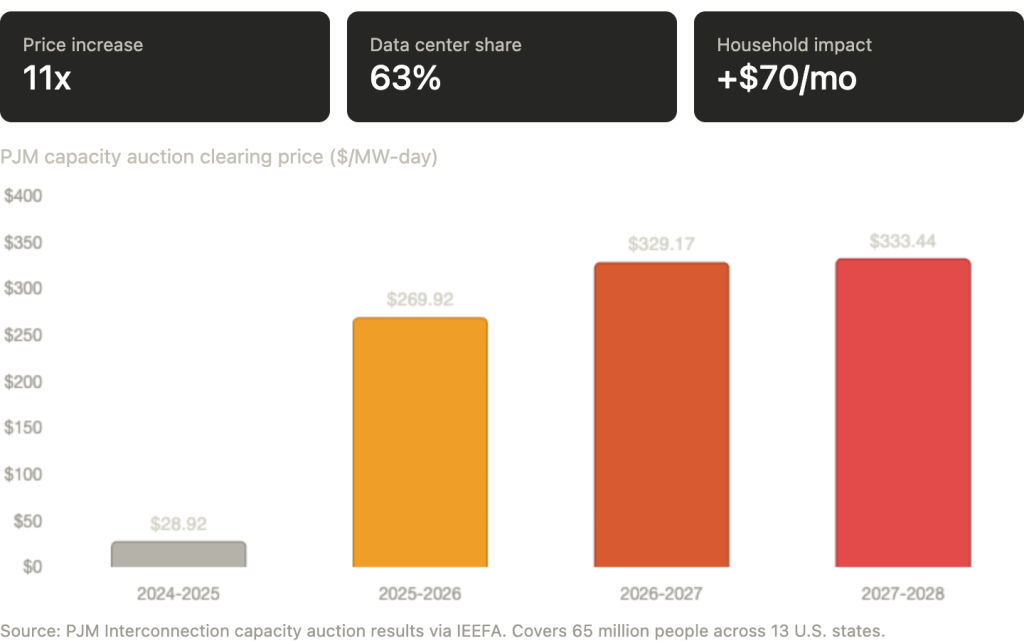
And the December 2025 auction made things worse: it hit a new record of $333.44 per megawatt-day while simultaneously failing to secure enough power to meet PJM’s reliability target, falling 6,625 megawatts short. For the first time in PJM history, a capacity auction couldn’t procure enough generation to keep the lights on during extreme conditions.
Why This Is Happening
The core problem is straightforward: electricity demand from data centers is growing faster than new power generation can be built. We broke down the actual energy cost of a single ChatGPT query – now multiply that by billions of daily requests.
PJM projects that peak electricity demand will grow by 32 gigawatts from 2024 to 2030, with all but 2 gigawatts coming from data centers. Meanwhile, more power plants have been retired than built in PJM’s service area over the past several years. New projects face interconnection delays, supply chain problems, and local opposition. Over 100 gigawatts of proposed generation (mostly solar, wind, and batteries) are stuck in PJM’s interconnection queue.
The result is a supply-demand imbalance that drives up prices through the capacity market. Utilities buy that capacity at auction, regulators approve cost recovery, and every customer in the region absorbs the increase, whether or not they use AI, own a data center, or even know what a chatbot is.
Virginia illustrates the extreme end. Data centers accounted for nearly 40% of all electricity used in the state in 2024. Northern Virginia’s “Data Center Alley” has the world’s largest concentration of these facilities, and Bloomberg found that areas near data center clusters saw wholesale electricity prices increase 267% over five years.
What the Government Is Doing About It
The political response has been fast and bipartisan, which tells you how real the problem is.
On March 25, 2026, Senator Bernie Sanders and Representative Alexandria Ocasio-Cortez introduced the Artificial Intelligence Data Center Moratorium Act, which would freeze all new AI data center construction nationwide until Congress passes comprehensive legislation on AI safety, worker protection, and energy impact. Over 100 local communities and 12 states have already enacted or proposed their own moratoriums. The bill is unlikely to pass in its current form, but it signals how seriously lawmakers are treating this.
On the other side, the Trump administration reached an agreement with a bipartisan group of governors to direct PJM to hold an emergency electricity auction, attempting to make tech companies pay for the construction of new power plants rather than passing those costs to residential customers.
States are also acting independently. Oregon created a dedicated data center rate class. Virginia’s SB 253 would shift distribution and capacity costs from households to data centers. Ohio is debating whether to eliminate data center tax breaks entirely. At least 238 data center-related bills were introduced across all 50 states in 2025.
The Counter-Argument: Could AI Actually Lower Bills?
This is the part that doesn’t get enough airtime. Not everyone agrees that AI data centers are net negative for electricity prices, and the counter-arguments have some substance.
NPR’s Planet Money ran a follow-up segment in April 2026 titled “Where AI Data Centers Are Reducing Power Bills,” exploring whether data centers are being scapegoated for long-standing issues with an aging U.S. grid. The argument goes: the grid needed massive investment regardless of AI. Coal and gas plants were already retiring. Transmission infrastructure was already overdue for upgrades. Data center demand is accelerating a reckoning that was coming anyway.
The investment AI is driving could, in theory, benefit everyone long-term. Tech companies are pouring hundreds of billions into new power generation, including nuclear, solar, and natural gas. If that new generation comes online and stays on the grid (rather than being exclusively reserved for data centers), the expanded supply could stabilize or reduce prices for everyone. The nuclear deals alone (Microsoft/Three Mile Island, Google/Kairos SMRs, Amazon/Susquehanna, Meta’s 6.6 GW nuclear portfolio) represent clean baseload generation that didn’t exist before AI created the economic incentive to build it.
The key word there is “could.” Right now, the new generation isn’t online yet, but the demand is. The gap between when data centers start consuming power and when new plants start producing it is the period where regular customers pay more. Whether that’s a 2-year gap or a 10-year gap determines whether this is a temporary growing pain or a structural cost shift.
Who’s Actually Affected Right Now
This isn’t hitting everyone equally. Your exposure depends almost entirely on where you live and how your local grid operator works.
If you live in the PJM region (Pennsylvania, New Jersey, Maryland, Virginia, Ohio, Illinois, parts of several other states), you’re feeling it now. Utility supply rates across PJM increased between 5% and 44% since June 2025. Washington D.C.’s Pepco residential customers saw bills go up an average of $21 per month. The Ohio couple profiled by NPR saw 60% over five years.
If you live in ERCOT territory (Texas), the picture is different. Despite massive data center growth, Texas’s energy-only market design, abundant solar and wind capacity, and faster interconnection timelines have kept prices more stable. A SemiAnalysis report found that forward energy prices in ERCOT increased 11-17% over the past year, notable but nothing like PJM’s 11x capacity spike. Texas benefits from a market structure that can add generation faster.
If you live elsewhere, the impact varies by state, by utility, and by how much data center demand exists in your region. California, Georgia, and parts of the Southeast are seeing growing pressure but haven’t experienced PJM-level price shocks yet.
What You Can Do
I’ll be direct: there’s not much an individual household can do about wholesale capacity prices. But there are a few practical steps.
If you live in a deregulated state (parts of Ohio, Pennsylvania, New Jersey, Illinois, Texas), you can compare electricity suppliers and lock in a fixed rate. This won’t eliminate the increase, but it can shield you from the worst monthly spikes.
Monitor your usage. Regardless of what’s happening at the grid level, reducing your consumption reduces your bill. LED bulbs, smart thermostats, and running major appliances during off-peak hours all help.
Pay attention to local politics. Data center cost allocation is being decided right now at the state level. Who pays for the infrastructure upgrades — ratepayers or tech companies — is a policy choice, not an inevitability. Showing up to public utility commission hearings or contacting your state representative actually matters on this issue more than most.
And if your bill has jumped significantly in the past year, check whether you’re in the PJM region. If you are, the capacity price surge is almost certainly a contributor. It’s not paranoia. The numbers support it.
I checked my own electricity bill after researching this. I’m not in the PJM region, but even here the rates have quietly crept up over the past year. The difference is, I at least now understand why.
Frequently Asked Questions
Is AI really raising my electricity bill?
It depends on where you live. If you’re in the PJM region (13 mid-Atlantic and Midwestern states), data center demand has driven capacity prices up roughly 11x in two years, and those costs are passed to all ratepayers. IEEFA found data centers were responsible for 63% of the price increase. Outside the PJM region, the impact varies significantly.
How much more could I be paying because of AI data centers?
The NRDC estimates the average PJM household could pay approximately $70 more per month by 2028. Current increases vary by utility: Pepco (D.C.) residential customers saw a $21/month increase starting June 2025. Some Ohio residents have seen 60% rate increases over five years. In Texas and other markets, the impact has been much smaller so far.
What is the Sanders-AOC Data Center Moratorium Act?
Introduced March 25, 2026, it would freeze all new AI data center construction in the U.S. until Congress passes comprehensive AI legislation addressing safety, worker protection, and energy impact. It’s unlikely to pass in its current form, but over 100 local communities and 12 states have already enacted or proposed their own moratoriums.
Could AI data centers actually lower electricity prices long-term?
Potentially. Tech companies are investing hundreds of billions in new power generation (nuclear, solar, natural gas) that could expand overall supply and eventually lower or stabilize prices. However, this benefit only materializes if the new generation comes online before demand outstrips existing supply, and if the power isn’t exclusively reserved for data centers. Right now, the new plants aren’t built yet, but the demand is already here.
What can I do about rising electricity costs from data centers?
In deregulated states, compare electricity suppliers and consider locking in a fixed rate. Reduce usage through efficiency improvements. Engage with local politics: data center cost allocation is being decided at the state level right now, and public input on utility rate cases matters.
This article is for informational purposes only. Electricity pricing varies by location, utility, and market structure. Consult your utility provider for specific rate information.


