How Much Water Does AI Use? The Hidden Cost of Every ChatGPT Prompt

We’ve all heard about AI’s electricity problem by now. But there’s a resource cost that gets far less attention, and it might be the one that actually hits harder in the long run: water.
Every time you ask ChatGPT to draft an email, summarize a document, or generate an image, servers in a data center somewhere run thousands of calculations. Those servers produce heat. That heat has to go somewhere. And the most common answer, for the majority of data centers on the planet, is water.
The numbers are startling enough that I think everyone using AI should know them.
The Viral Number: 519ml Per Email
UC Riverside researcher Shaolei Ren, in collaboration with the Washington Post, calculated that using ChatGPT’s GPT-4 model to generate a single 100-word email consumes approximately 519 milliliters of water. That’s roughly one standard water bottle.
That number includes both direct water (used on-site to cool servers) and indirect water (used at power plants that generate the electricity feeding those servers). The indirect water is the piece most people miss. Data centers don’t just drink water themselves. The power plants supplying them do too.
For context, Ren’s earlier research estimated that a session of 10 to 50 GPT-3 prompts (simpler, shorter queries) uses about 500ml total. A more complex GPT-4 task like email generation pushes that usage higher per individual query. The specific number depends on which model you’re using, how long the response is, and critically, where the data center is located and what time of year it is. Data centers in cooler climates or those using air cooling instead of evaporative cooling use substantially less water.
But the per-query number isn’t really the point. One bottle of water doesn’t matter. Multiply it by billions and it starts to matter a lot.
How Much Water Are We Actually Talking About?
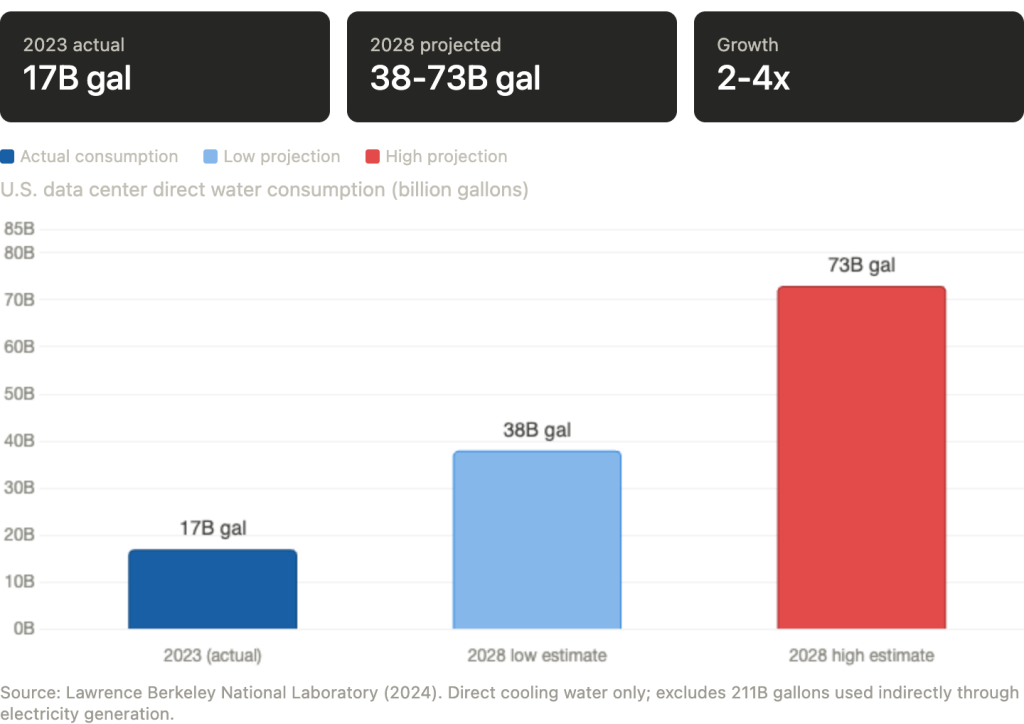
A 2024 report from Lawrence Berkeley National Laboratory estimated that U.S. data centers consumed approximately 17 billion gallons of water directly through cooling in 2023. That’s equivalent to the annual water usage of roughly 160,000 American households. And that’s just the direct cooling water. The same report estimated an additional 211 billion gallons consumed indirectly through the electricity that powers those centers.
The projections are where it gets concerning. Direct water consumption is projected to rise to between 38 and 73 billion gallons by 2028, representing a doubling to quadrupling in five years. Hyperscale data centers (the massive AI-focused facilities being built by Meta, Google, Amazon, and Microsoft) are expected to account for half of that consumption.
Google alone consumed 6.4 billion gallons of water globally in 2023, with 95% used by data centers. A single Google data center in Council Bluffs, Iowa consumed 1 billion gallons in 2024. Meta’s global data center water consumption hit 776 million gallons in 2023. Microsoft reported a 34% spike in global water consumption between 2021 and 2022, and Ren attributed the majority of that growth to AI.
Meta’s Hyperion: The Scale Problem Made Visible
The most vivid illustration of this issue is Meta’s Hyperion campus in Richland Parish, Louisiana. When complete around 2030, this facility, the largest data center in the Western Hemisphere, is registered to consume up to 23 million gallons of water per day. That’s more water than a town of 17,000 people uses daily. Holly Ridge, the community where it’s being built, has a population of fewer than 2,000.
Meta says actual daily usage will be lower than the registered maximum, estimating 500 to 600 million gallons per year. Even at that lower estimate, it’s three times the water consumption of Meta’s previous most intensive data center. The water will come from the Mississippi River Alluvial Aquifer, which also serves local farms and communities.
Gulf States Newsroom reported in April 2026 that residents of Holly Ridge are already drinking only bottled water, describing their tap water as having a “disinfectant” smell and sometimes running brown. The Sierra Club has formally requested an independent environmental assessment. None has been ordered by Louisiana regulators.
This isn’t just a Louisiana story. In Newton County, Georgia, a Meta data center opened in 2018 uses 500,000 gallons per day, 10% of the entire county’s water consumption. Families living near it have reported their taps going dry.
Where the Water Actually Goes
Understanding why data centers need so much water helps explain why this is hard to fix.
Direct cooling is the primary use. Most large data centers use evaporative cooling: water absorbs heat from the servers, then evaporates into the atmosphere through cooling towers. The water that evaporates is gone. It doesn’t return to the local water supply. This is “consumptive” use, not just withdrawal.
Indirect use is even larger. The power plants generating electricity for data centers also use water for cooling, particularly coal, natural gas, and nuclear plants. We broke down exactly how much electricity each ChatGPT query costs, and the water needed to produce that electricity is 10 to 12 times larger than the direct cooling water. This indirect footprint can be 10 to 12 times larger than the direct cooling water.
Manufacturing adds another layer. Producing a single microchip requires 2 to 3 gallons of water. The servers inside data centers contain thousands of chips, and those servers are replaced every few years.
The Political Response Is Accelerating
On April 9, 2026, Maine’s legislature passed a one-year moratorium on data centers larger than 20 megawatts, the first statewide ban of its kind in the country. Water concerns were explicitly cited alongside electricity costs. The bill, LD 307, keeps the ban in effect until November 2027 while regulators design rules for large data center developments. It’s currently awaiting the governor’s signature.
Maine’s moratorium follows the Sanders-AOC AI Data Center Moratorium Act introduced at the federal level in March 2026, which we covered in our piece on how AI is affecting electricity prices, and mirrors growing resistance at the local level. CNN reported that numerous municipalities have defeated data center proposals in zoning board votes before packed rooms of angry residents.
The Environmental and Energy Study Institute (EESI) published a detailed analysis of data center water consumption, noting that fewer than one-third of data center operators even track their water usage and calling for mandatory reporting and transparency requirements.
The Counter-Argument: Not Every Data Center Is a Water Hog
It would be dishonest to pretend that all data centers have the same water footprint, because they don’t.
Air-cooled data centers use significantly less water than evaporative-cooled ones. Some newer facilities in cooler climates (Scandinavia, parts of the Pacific Northwest) use outside air for cooling most of the year, drastically reducing or eliminating direct water consumption.
Closed-loop systems recirculate water rather than evaporating it, though they’re less efficient at removing heat and more expensive to build.
Recycled and non-potable water is an emerging approach. Some data centers are exploring the use of treated wastewater or gray water for cooling, which doesn’t compete with drinking water supplies.
Renewable energy also reduces the indirect water footprint. Solar and wind power don’t require cooling water the way fossil fuel and nuclear plants do. Tech companies that genuinely shift to renewable electricity (not just purchasing offset credits) reduce the total water impact of their operations.
Google, for example, has committed to replenishing 120% of the freshwater it consumes by 2030. Whether these pledges translate into real-world results at the scale needed remains to be seen, but the infrastructure is being built.
The problem isn’t that solutions don’t exist. It’s that the cheapest, fastest way to build a data center is still the water-intensive way, and the pace of construction is outrunning the pace of implementing alternatives.
What This Means for Regular People
Unlike electricity costs, water impacts from data centers are harder to trace to your individual bill. You probably won’t see a line item that says “AI cooling surcharge.” But the effects are real, especially if you live near a large data center cluster.
In areas with heavy data center concentration, groundwater levels can drop, well water quality can degrade, and municipal water systems can come under strain. These impacts fall disproportionately on rural and lower-income communities, which is part of why the political backlash has been so intense.
As someone who follows tech closely and uses AI tools daily, I think the water story is actually more concerning than the electricity story in the long term. Electricity can be generated from multiple sources, and new generation can be built. Fresh water is finite in ways electricity isn’t. And we’re building permanent infrastructure that assumes water availability in regions where that assumption may not hold for decades.
The electricity numbers are abstract to most people. Water isn’t. You can hold a bottle of water. You can watch a tap run dry. That’s what makes this the AI cost story that should be getting more attention than it is.
Frequently Asked Questions
How much water does a single ChatGPT query use?
It varies by model and task complexity. UC Riverside researcher Shaolei Ren calculated that generating a 100-word email with GPT-4 uses approximately 519ml of water (about one bottle), including both direct cooling and indirect electricity generation. Simpler queries use less, a session of 10-50 basic GPT-3 prompts uses approximately 500ml total.
How much water do U.S. data centers use in total?
The Lawrence Berkeley National Laboratory estimated U.S. data centers consumed approximately 17 billion gallons of water directly in 2023, with an additional 211 billion gallons used indirectly through electricity generation. Direct consumption is projected to reach 38-73 billion gallons by 2028.
Which tech company uses the most water for AI?
Google consumed 6.4 billion gallons globally in 2023 (95% at data centers). Meta consumed 776 million gallons (95% at data centers). Microsoft reported a 34% increase in water consumption between 2021-2022, largely attributed to AI. Amazon does not publicly disclose aggregate water totals.
Are there data centers that don’t use water?
Yes. Air-cooled facilities in cooler climates can operate with minimal direct water use. Some facilities use closed-loop systems that recirculate water. Others are exploring recycled wastewater for cooling. However, these approaches are more expensive, and the majority of data centers globally still rely on evaporative cooling.
Has any state banned data centers over water concerns?
Maine passed the first statewide data center moratorium in April 2026, banning facilities over 20 megawatts until November 2027. Water concerns were explicitly cited alongside electricity costs. Over 100 local communities nationwide have enacted or proposed similar restrictions.
This article is for informational purposes only. Water usage figures represent estimates from published research and may vary based on data center location, cooling technology, climate, and energy sources.


