OpenAI Just Raised $122 Billion. Here’s What That Actually Means for You.

OpenAI just closed the largest private funding round in the history of technology. Not the largest this year. Not the largest in AI. The largest, period.
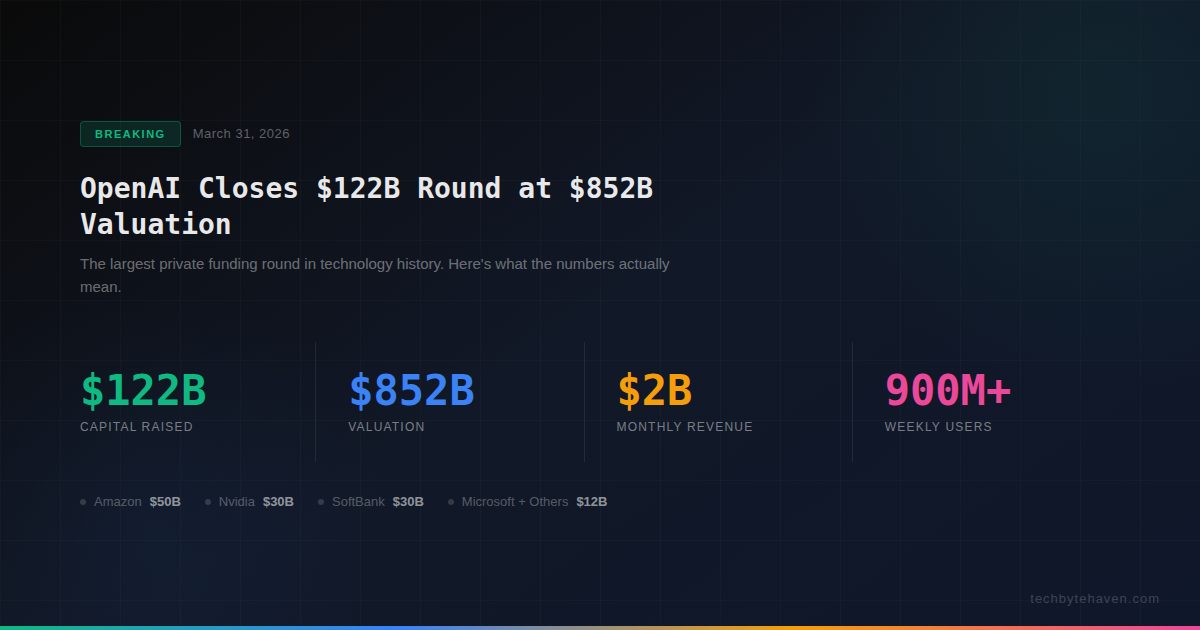
The company announced on March 31 that it raised $122 billion in committed capital, pushing its valuation to $852 billion. To put that in perspective, that valuation is larger than JPMorgan Chase, Visa, or Samsung. And OpenAI is still a private company that has never turned a profit.
As someone who follows tech daily and has used ChatGPT since the early days, the number is so absurd that it almost doesn’t register. But the details behind it reveal a lot about where AI is heading in 2026, what’s getting funded, and what’s getting killed to make it work.
Where the Money Came From
The bulk of the financing came from three major tech companies. Amazon agreed to invest $50 billion, while Nvidia and SoftBank each contributed $30 billion. SoftBank co-led the round alongside Andreessen Horowitz and D.E. Shaw Ventures.
About $3 billion came from individual investors through bank channels, a first for OpenAI. The company also announced it would be included in several ARK Invest ETFs, giving everyday investors a way to buy into OpenAI before a potential IPO.
Microsoft, one of OpenAI’s longtime partners, also participated, though the company did not disclose the size of its investment.
Here’s the detail that should make you pay attention: a large portion of Amazon’s investment, $35 billion, is contingent on OpenAI going public or reaching artificial general intelligence. In other words, Amazon isn’t writing a blank check. It’s making a bet with conditions attached.
The Numbers Behind the Hype
OpenAI shared a batch of metrics alongside the funding announcement, and the growth trajectory is genuinely staggering.
The company said it is generating about $2 billion in monthly revenue, with more than 900 million weekly active users on ChatGPT and enterprise customers accounting for over 40% of revenue. The company also said it has over 50 million subscribers, and its APIs now process more than 15 billion tokens per minute.
Its Codex coding agent serves over 2 million weekly users, up 5x in three months. And perhaps most surprisingly, its ads pilot is bringing in more than $100 million in annual recurring revenue in under six weeks, which signals that advertising is about to become a serious revenue stream for ChatGPT.
Those are real numbers. But context matters. The company is still burning cash and is not yet profitable. Revenue is enormous and growing fast, but the infrastructure costs to run AI at this scale are equally enormous.
What OpenAI Plans to Build With It
The company has been surprisingly specific about where this money is going.
OpenAI said the funding will support expanded compute infrastructure, multi-cloud and chip partnerships, and development of a unified “AI superapp” combining ChatGPT, Codex, and agentic capabilities.
That superapp concept is worth unpacking. OpenAI is essentially saying that ChatGPT, its coding tools, and its web browsing capabilities will merge into a single product that can take actions across your apps and workflows. Not just answer questions, but actually do things for you. The company stated that “users do not want disconnected tools. They want a single system that can understand intent, take action, and operate across applications, data, and workflows.”
On the infrastructure side, OpenAI’s stack now spans multiple cloud platforms, including Microsoft, Oracle, AWS, CoreWeave and Google Cloud, alongside chip partnerships with Nvidia, AMD, Cerebras and custom chips developed with Broadcom.
That diversification is a strategic move. OpenAI is making sure it’s not completely dependent on any single cloud provider or chip maker. As someone who’s built PCs and watched the GPU market closely for years, this is the kind of supply chain thinking that separates companies that scale from companies that hit a wall.
The Sora Shutdown: A $1 Million-a-Day Lesson
While OpenAI celebrates this record funding round, it’s also quietly cleaning house. Just one week before the funding announcement, OpenAI said it would shut down its Sora AI video-generation app.
According to a WSJ investigation, Sora was burning roughly $1 million every day in compute costs while users were fleeing. Downloads fell from about 3.3 million in November 2025 to just over 1.1 million by February 2026, a decline of roughly 66% in three months.
The Disney partnership, which had included a licensing agreement allowing Disney characters to be used within Sora and a planned $1 billion investment, collapsed along with it. Disney stated it “respects OpenAI’s decision to exit the video generation business.”
[Image: openai-sora-shutdown-timeline.jpg — Alt text: Timeline showing OpenAI Sora launch to shutdown in six months]
This matters because it reveals OpenAI’s real priorities heading into 2026. Video generation is flashy, but it’s not where the money is. Enterprise tools, coding assistants, and the “superapp” concept are where OpenAI is betting its future. And with an IPO potentially coming later this year, every dollar of compute needs to be pointed at revenue generation.
The Elephant in the Room: Is This a Bubble?
Not everyone is celebrating. Critics are wary of the speculative nature of such a high valuation, drawing parallels to previous tech bubbles where valuations were inflated without corresponding profitability.
Commentators have been quick to point out that OpenAI’s investor list has significant crossover with its suppliers. Nvidia sells OpenAI chips and invests $30 billion. Microsoft runs OpenAI’s cloud infrastructure and is an investor. Amazon provides AWS and invests $50 billion. The money flows in circles, which makes it harder to tell where the real revenue is and where it’s just companies investing in their own customer.
HSBC projects that OpenAI’s cumulative free cash flow by 2030 will still be negative, leaving a $207 billion funding shortfall that must be filled through additional debt, equity, or more aggressive revenue generation. That’s a significant gap between what OpenAI needs and what it currently has.
As one investment officer put it, “to become profitable, they really need to transition from what is essentially a subsidised research laboratory to an enterprise software juggernaut, where their core products are being used by everyone.”
And many have raised concerns about AI data centers’ energy consumption, leading to higher electricity prices, along with their heavy water usage. The infrastructure AI needs to run isn’t just expensive. It has real environmental costs that the general public is starting to notice.
What This Means for Regular Users
Here’s the practical takeaway. If you use ChatGPT, expect it to get better and more integrated into everything. The superapp is coming, and it will likely combine chat, code generation, web browsing, and task automation into one interface. OpenAI’s latest model, GPT-5.4, is reportedly driving record engagement across agentic workflows.
If you’re a developer, the Codex tools are clearly OpenAI’s growth engine right now, and they’ll get more investment.
If you used Sora, start exploring alternatives. The Sora app is scheduled to shut down on April 26, 2026, and the API on September 24, 2026.
And if you’re thinking about investing, OpenAI is expected to hit the public markets this year. The ARK Invest ETF inclusion is the first step toward making OpenAI accessible to retail investors. But keep in mind: this is a company valued at $852 billion that has never turned a profit. The opportunity is real, and so is the risk.
[Image: openai-valuation-growth-chart.jpg — Alt text: Chart showing OpenAI’s valuation growth from 2023 to 2026]
The Bottom Line
OpenAI’s $122 billion round is a bet that AI infrastructure is the new electricity, the new internet, the new foundational layer of the economy. Maybe that’s right. The revenue growth, user numbers, and enterprise adoption suggest there’s genuine demand, not just hype. But the company is still unprofitable, its biggest consumer product (Sora) just got killed for burning too much money, and the gap between what it needs to spend and what it earns is measured in hundreds of billions.
The AI era isn’t coming. It’s already here. The question is whether the economics can keep up with the ambition.
Frequently Asked Questions
How much did OpenAI raise in its latest funding round?
OpenAI closed $122 billion in committed capital on March 31, 2026, at an $852 billion post-money valuation. Major investors include Amazon ($50 billion), Nvidia ($30 billion), and SoftBank ($30 billion).
Is OpenAI profitable?
No. Despite generating $2 billion in monthly revenue and having over 900 million weekly active users, OpenAI is still not profitable. The infrastructure costs required to train and run AI models at scale continue to exceed revenue.
Why did OpenAI shut down Sora?
OpenAI’s Sora video generator was reportedly costing roughly $1 million per day in compute while usage declined sharply. Downloads dropped by about 66% between November 2025 and February 2026. OpenAI is reallocating those resources toward enterprise products and its planned superapp.
Is OpenAI going public in 2026?
An IPO is widely expected in the second half of 2026, though OpenAI hasn’t confirmed a specific date. The company has expanded its investor base through bank channels and ARK Invest ETFs in what many analysts see as pre-IPO positioning.
What is OpenAI’s superapp?
OpenAI is building a unified desktop and mobile application that combines ChatGPT, Codex (its coding agent), web browsing, and agentic AI capabilities into a single interface. The goal is a product that can take actions across your apps and workflows, not just generate text.


