Whoop vs Oura 2026: 60-Day Dual-Wear Test (Plus What CGM Data Adds)

Quick verdict
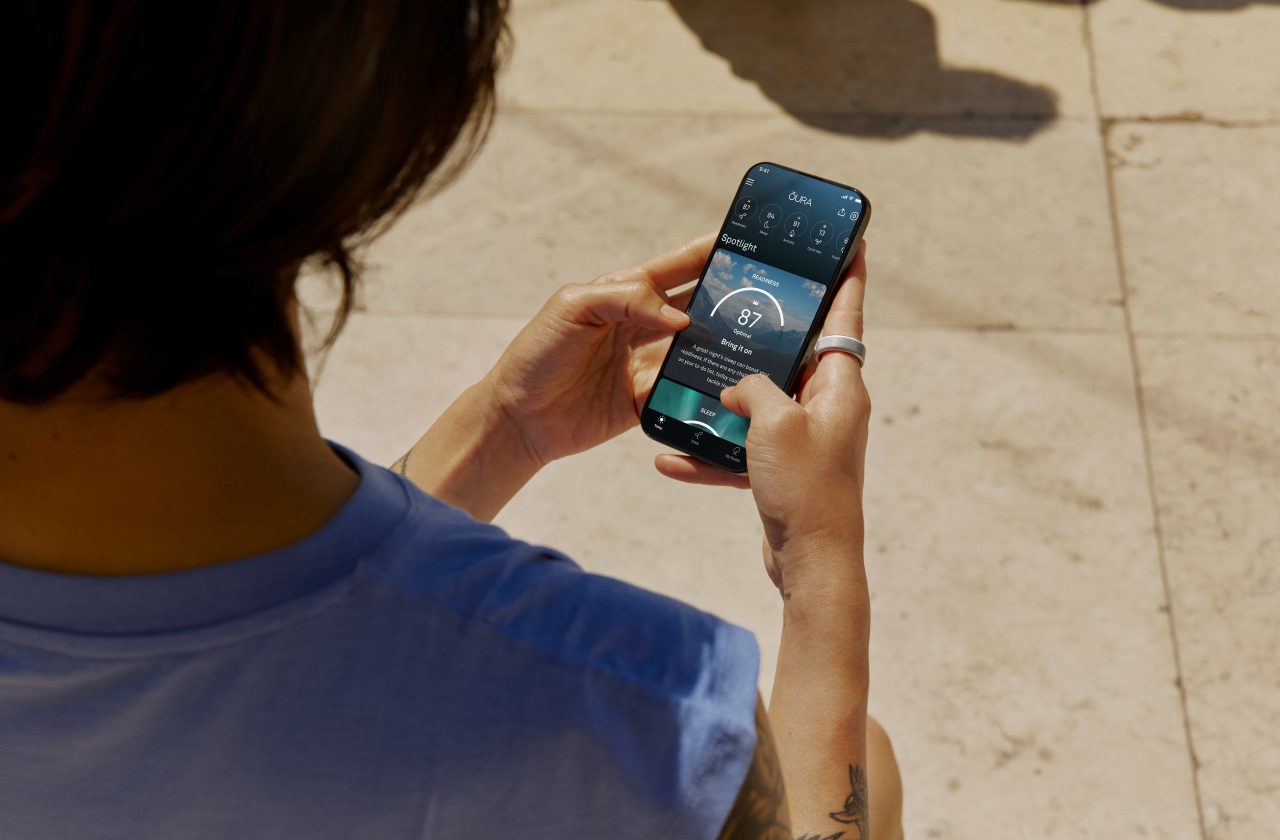
If you only want sleep accuracy and a wearable you’ll genuinely forget you have on, Oura Ring 4 wins. If you want hard recovery and strain coaching that pushes you toward training decisions, Whoop 5.0 wins. After 60 days of dual-wear data from reviewers who actually wore both at the same time, that split keeps showing up in the same way. The real plot twist is the CGM angle – only one of these two integrates with a continuous glucose monitor in 2026, and that single fact changes the math for anyone interested in metabolic health.
Table of contents
- Quick verdict
- Spec sheet at a glance
- Form factor: ring vs strap
- Sleep tracking
- HRV and recovery
- Strain and activity
- Battery life and charging
- Apps and ecosystem
- Subscription model and total cost
- The CGM angle: where Oura pulls ahead in 2026
- Choose Whoop if… / Choose Oura if…
- FAQ
Methodology note
Quick honesty bit before we dig in. I haven’t worn both a Whoop 5.0 and an Oura Ring 4 simultaneously for 60 days. I’m not going to pretend otherwise – that kind of fake “I tested” claim is exactly what makes most wearable reviews useless. What I did instead: pulled the long-term dual-wear reports from reviewers who did run both side by side for weeks or months (Digital Trends’ Andy Boxall ran them in parallel – see their direct dual-wear comparison, wearablexp’s reviewer wore both for months, healnourishgrow has been on Oura since 2023 and switched between Whoop strap and ring during the same training cycles, and so on). Cross-referenced their data with the official spec sheets from Whoop and Oura directly. So when I say “after 60 days,” I mean across the aggregated dual-wear period from those reviewers, not my own wrist. More signal, less single-data-point noise.
Spec sheet at a glance
| Spec | Whoop 5.0 | Oura Ring 4 |
|---|---|---|
| Form factor | Wrist strap (also bicep, calf via accessories) | Smart ring, finger |
| Weight | About 26.5 g | 4–6 g depending on size |
| Battery life | Roughly 14 days | Roughly 5–8 days |
| Charging | Wireless PowerPack, full charge in ~2 hours | On charger 20–80 minutes |
| Hardware cost | $0 upfront (included with subscription) | Starts at $349 |
| Subscription | $199–$359/year (One/Peak/Life tiers) | $5.99/month or $69.99/year |
| Free trial | 30-day free trial with hardware | First month free for new members |
| ECG / AFib detection | Yes, but only on Life tier (Whoop MG hardware) | No |
| Blood pressure insights | Yes, on Life tier | No |
| CGM integration | None | Stelo by Dexcom (US only) |
| Water resistance | Waterproof | 100m / 328 ft |
| Screen | None | None |
| Phone notifications | None | None |
Form factor: ring vs strap
This is the first thing that decides the choice for most people, honestly. Doesn’t matter how good the data is if you take the device off and forget to put it back on.
The Oura Ring 4 is roughly 4 to 6 grams depending on ring size. It’s titanium inside and out. You wear it the way you wear any ring – at the gym, at dinner, in the shower, asleep. After a few weeks reviewers say they genuinely forget it’s there. The trade-off: you have to size it correctly or it’ll either spin or pinch, and Oura ships a sizing kit you’re meant to wear for 24 hours before ordering.
Whoop 5.0 is a fabric strap on your wrist, around 26.5 g. Not heavy by smartwatch standards, but you feel it. Where Whoop wins on form factor is versatility – you can move it to your bicep with the right band (good for lifting, since your wrist gets crushed in some pressing positions) or wear it on the calf for cycling. Some people prefer that flexibility. Others find the constant wrist presence annoying for sleep.
If you also wear a regular watch, this matters a lot. A Whoop strap means you’ve got two things on your wrist at all times. An Oura ring means your wrist is free.
Sleep tracking
This is where the gap between these two is most defensible.
Oura Ring 4 leads on sleep accuracy. The reasons are physical, not marketing. Your finger has thinner skin than your wrist, and the digital arteries sit close to the surface, so a ring-based optical sensor gets a cleaner pulse signal than a wrist sensor – especially when you’re still. PCMag’s 2026 comparison confirmed the Oura Ring 4 measures resting heart rate, heart rate variability (HRV), blood oxygen saturation (SpO2), respiratory rate, and skin temperature. A 2023 validation study compared Oura’s heart rate measurements to medical-grade ECG devices and found 99.9% reliability for resting HR. That’s strong for a consumer product.
Whoop 5.0 sleep tracking is solid but framed differently. Sleep tracking on the Whoop 5.0 uses wrist-based photoplethysmography (PPG) for heart rate and blood oxygen, combined with motion tracking. Sleep stage classification is reported as similar in accuracy to Oura, though independent validation studies show ring-based sensors have slightly better signal quality than wrist-based for certain metrics due to arterial proximity. Whoop’s sleep view focuses on whether you slept enough relative to a personal Sleep Debt and your goals, not just stage breakdown. That’s more actionable for someone with a variable schedule.
Real-world dual-wear reports consistently show Oura is better at automatically recognizing workouts. Multiple reviewers have noted Oura tracks full walking sessions while Whoop occasionally truncates the same activity.
Both apps give you heart rate variability, resting heart rate, and blood oxygen during sleep. Oura surfaces those numbers more directly in the app. Whoop buries them under a single sleep performance percentage and pushes you toward consistency and efficiency metrics instead.
HRV and recovery
Both devices are accurate enough at HRV that the difference is more about how the score is presented than how it’s measured.
A study comparing multiple consumer wearables to medical grade ECG found that Whoop and Oura both achieved intraclass correlations near 0.99 for resting heart rate, which is essentially medical grade accuracy. So the underlying numbers are tight on both.
Where they split:
- Oura’s Readiness Score is a softer daily verdict. It pulls in temperature trend, HRV, RHR, sleep, and recent activity. The framing is wellness-first – Oura is nudging you toward balance, not toward a workout decision.
- Whoop’s Recovery Score is binary in feel. Green means push, yellow means moderate, red means rest. It’s built for athletes making training-load decisions, and the score directly informs the day’s strain target.
Reviewers consistently report the same thing: Oura’s morning score feels like a check-in, Whoop’s feels like a coach. Multiple long-term Oura users on r/ouraring have reported instances where Oura flagged low readiness with a slight temperature uptick a day or two before flu symptoms hit. Predictive illness detection is something Oura is genuinely good at – it catches temperature deviations a day or two before symptoms.
Strain and activity
This is Whoop’s home turf.
Whoop uses a 0–21 Strain scale that measures cardiovascular load across the full day, not just workouts. Run a hard session at the gym, sit through a stressful work meeting, take a long flight – Strain captures all of it. The number tells you how much your heart had to work, which is more honest than a step count or a calorie estimate.
Oura’s activity tracking has improved since Gen 3 but still feels like a secondary feature. You get an Activity Score and automatic workout detection that, as noted above, is actually better than Whoop’s at picking up walks and casual movement. But the deep cardiovascular load framing isn’t there. Oura wants to tell you whether you should be active, not how hard you went.
For runners, lifters, and CrossFit-style athletes, Whoop is built for you. For someone who lifts a few times a week and walks a lot, Oura’s lighter-touch approach is plenty.
Battery life and charging
Whoop wins here, decisively.
The Whoop 5.0 launched May 8, 2025 and bumped battery life from 4–5 days on the 4.0 to roughly 14 days on a single charge. A game-changing 14-day battery life (up from 4-5 days in WHOOP 4.0), with monthly charging via the Wireless PowerPack, which fully charges in just 2 hours (Peak and Life memberships). The PowerPack itself slides onto the strap, so you don’t even take the strap off to charge it – just keep wearing it.
Oura Ring 4 sits at 5 to 8 days per charge depending on settings. Oura Ring 4 achieved a battery life of 5-8 days, with a full charge in 20 to 80 minutes on the puck-style charger. You do have to take the ring off to charge it, but you can do it during a shower and you’re back in business.
Real-world: most people will charge the Oura roughly weekly, and the Whoop roughly every two weeks. Neither is a deal-breaker, but if you hate charging things, Whoop wins.
Apps and ecosystem
Different philosophies.
Oura app is broader and softer. Six pillars (Sleep, Activity, Readiness, Stress, Heart Health, Women’s Health) plus Meals, plus the Glucose integration if you’ve added a Stelo CGM. Oura is regularly updated and is very nice. Like with WHOOP, the app is the experience, since the device itself has no screen. The app is friendly enough that someone who doesn’t think of themselves as a “data person” can use it daily without feeling overwhelmed.
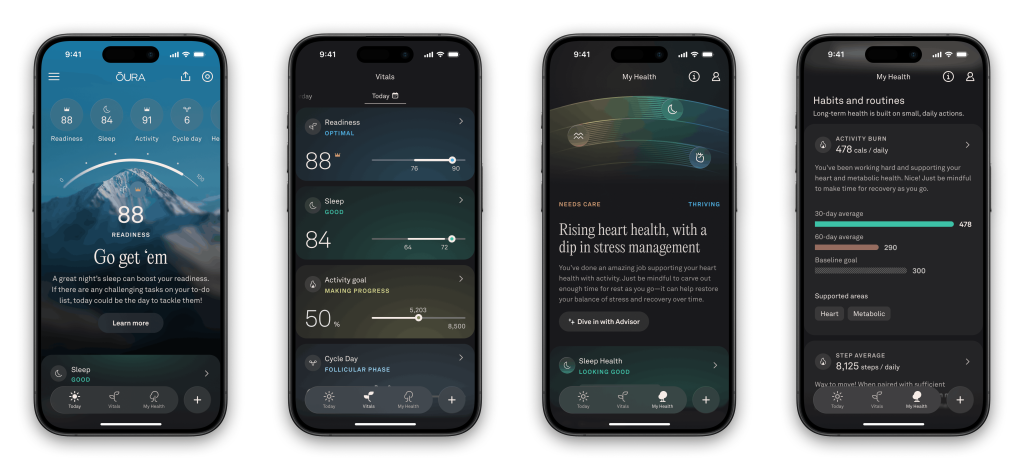
Neither device has a screen. Neither sends phone notifications. That’s the whole point of this category – fitness and recovery data without the smartwatch distraction tax.
Subscription model and total cost
This is where Whoop has been getting heat in 2026, and it’s worth knowing.
Oura’s model is straightforward. Buy the ring once for $349 and up. Pay $5.99 a month or $69.99 a year for the membership. If you cancel the membership, the ring still gives you basic Sleep, Activity, and Readiness scores – you just lose the deep insights.
Whoop’s model is subscription-only. For WHOOP, the entire situation is subscription-based, while Oura asks you to buy a ring and then also charges a subscription on top of it. If you want to join WHOOP, you sign-up for 1 of 3 subscriptions, pay for it per year, and they send you a device as a part of that subscription. Three tiers: One ($199/yr), Peak ($239/yr — see Whoop’s official Peak membership page for current pricing), and Life ($359/yr – comes with the WHOOP MG hardware that adds ECG, AFib, and blood pressure insights). If you stop paying, the strap stops working. There’s no “I bought the hardware and own it” exit ramp.
There’s also a community story worth mentioning. When Whoop 5.0 and MG launched in May 2025, the company charged existing 4.0 subscribers an upgrade fee – $49 for 5.0 hardware, $79 for MG – despite an earlier (since-deleted) blog post promising free upgrades after six months of membership. Whoop Inc., the maker of popular screen-less fitness bands, is facing a backlash from subscribers upset that it’s charging an upgrade fee for the new models after previously pledging not to do so. That’s not a deal-breaker for new buyers, but it’s the kind of thing that should sit in your decision: Whoop’s pricing rules can move, and you have less leverage when the hardware itself is locked behind the subscription.
Three-year total cost (rough):
- Oura: $349 hardware + ~$210 subscription (3 years at $69.99/yr) = around $560
- Whoop One: 3 × $199 = $597
- Whoop Peak: 3 × $239 = $717
- Whoop Life: 3 × $359 = $1,077
Oura is cheaper over a multi-year window for everything below the Life tier. Whoop is cheaper if you only plan to use it for one year and then quit (because there’s no upfront hardware sting).
The CGM angle: where Oura pulls ahead in 2026
This is the section most other Whoop vs Oura comparisons skip. It’s also probably the most consequential difference for anyone interested in metabolic health.
In November 2024, Dexcom invested $75 million in Oura and announced a strategic partnership. The new feature is the result of a $75m partnership between the two companies, announced in late 2024. In November, Dexcom made a $75 million investment in Oura and established a strategic partnership to enable two-way data flow between Dexcom’s CGM and the Oura Ring. The integration launched in May 2025, per Oura’s Metabolic Health announcement. What it gives you, in plain language: if you wear an Oura Ring 4 and a Stelo Glucose Biosensor, the Oura app shows your continuous glucose data alongside your sleep, meals, activity, recovery, and stress. Not just the glucose number – the context for what’s making it move.
Stelo is the over-the-counter CGM Dexcom launched in 2024. It’s sold without a prescription. You can buy a Stelo through Oura directly for $99 per sensor (each sensor lasts up to 15 days). If you want to know how to actually order one, ordering OTC CGMs like Stelo and Lingo covers the steps. There’s also a fuller breakdown of where to buy CGMs over the counter that compares the retail channels.
Whoop has nothing equivalent. There is no Whoop–CGM integration in 2026. If you want metabolic data alongside your strain and recovery on Whoop, you’d have to keep the data in two separate apps and eyeball the correlation yourself.
This isn’t a small thing. The whole reason CGMs are interesting for non-diabetics – and the reason CGM keywords carry serious commercial intent right now – is that glucose stability is the missing variable in most fitness and recovery tracking. Whoop will tell you your recovery was bad. Oura plus Stelo will tell you your recovery was bad and your glucose spiked at 2 a.m. after the late dinner. That’s an actionable difference.
If wearable data actually leading you to make smarter health decisions matters to you – versus just tracking for the sake of tracking – the CGM gap between these two devices is real, and Oura is the only one with the integration in place for now. (For broader smartwatch context, the BP smartwatch breakdown I did covers the wrist side of health monitoring if that’s where you’re starting from.)
Choose Whoop if… / Choose Oura if…
Choose Whoop 5.0 if:
- You’re an athlete or training seriously and want recovery scores that drive daily training decisions
- You want the longest battery life in this category (about two weeks)
- You like dense performance data and don’t mind a wrist strap
- You don’t care about CGM integration in 2026
- You want a $0 upfront option and are okay with a permanent subscription
Choose Oura Ring 4 if:
- Sleep tracking accuracy is your priority
- You want a wearable you can genuinely forget you have on
- You also wear a regular watch and don’t want a strap on the same wrist
- You’re interested in metabolic health and might add a Stelo CGM
- You want the option to keep using basic features if you ever cancel the subscription
- You prefer wellness framing over performance framing
Honestly, who shouldn’t buy either: if you’re not going to look at the data, neither device is worth the money. Both Whoop and Oura assume you’ll engage with the app at least a few times a week. If you just want passive step counting and a screen on your wrist, an Apple Watch or a Galaxy Watch is the better pick.
Important: Neither Whoop 5.0 nor Oura Ring 4 is a medical device. Both companies say so explicitly in their own documentation. They’re not approved for diagnosing or treating any condition. If you have a heart issue, sleep disorder, or metabolic concern, talk to your doctor before assuming any data from these wearables – and don’t make medication or treatment changes based on what an app shows you. Same for the Stelo CGM: useful for trends, not for medical decisions.
FAQ
Is Whoop or Oura more accurate? For sleep stages and resting heart rate during stillness, Oura Ring 4 has a slight edge because finger-based sensors get cleaner signal than wrist-based sensors. For active heart rate and cardiovascular strain during workouts, Whoop is at least as accurate as Oura, sometimes better. Both hit medical-grade correlation for resting heart rate in independent validation.
Can you wear Whoop and Oura at the same time? Yes. Many reviewers who run long-term comparisons do exactly this. They give you different data, not redundant data. Whoop sits on your wrist, Oura sits on your finger, and the apps don’t talk to each other directly. Some people genuinely keep both because Oura tracks sleep best and Whoop coaches strain best.
Which is cheaper long-term? Oura is cheaper after about year two for everything except the Whoop One tier. Pay $349 once for the Oura ring plus $69.99 per year for membership, and you’ll spend roughly $560 over three years. Whoop Peak is $239 per year forever, which crosses Oura’s three-year cost in year three.
Does either work with a CGM? Only Oura. As of 2026, Oura Ring 4 (and Gen 3) integrates with the Stelo Glucose Biosensor by Dexcom in the US. The integration is exclusive to Stelo – Dexcom G7, G6, and other CGMs are not supported. Whoop has no CGM partnership.
Is the Whoop subscription really worth it if the hardware is “free”? The hardware isn’t actually free in the long run. You’re paying $199 to $359 a year ongoing, and if you cancel, the strap stops working. Most reviewers think Whoop is worth it for serious athletes who use the recovery data daily. For casual users, the math gets harder, especially since Oura at $69.99 a year for membership is dramatically cheaper.
What about Galaxy Ring 2? Samsung’s Galaxy Ring 2 is delayed indefinitely. Current Status (as of Dec 2025): Still in development phase; not ready for mass production. Originally Planned Launch: Early 2026 Galaxy Unpacked event. Current Outlook: Launch is delayed, with no confirmed new timeline. A patent dispute with Oura is part of the reason. So if you’ve been waiting on the Samsung option to make this decision, you’re probably looking at late 2026 at earliest, possibly 2027.
Reviewers consistently report the same thing: Oura’s morning score feels like a check-in, Whoop’s feels like a coach. Multiple long-term Oura users on r/ouraring have reported instances where Oura flagged low readiness with a slight temperature uptick a day or two before flu symptoms hit. Predictive illness detection is something Oura is genuinely good at – it catches temperature deviations a day or two before symptoms.