Why Your Next Phone Costs More Because of AI (And Whether to Buy Now or Wait)

If you’ve been shopping for a new phone this year and noticed that everything seems to cost more for what feels like less, you’re not imagining it. Smartphone prices are going up in 2026, and the reason isn’t inflation, tariffs, or manufacturers being greedy (though some of that is happening too). The biggest driver is something most people have never heard of: AI companies are buying up the world’s memory chip supply, and smartphone manufacturers are getting squeezed.
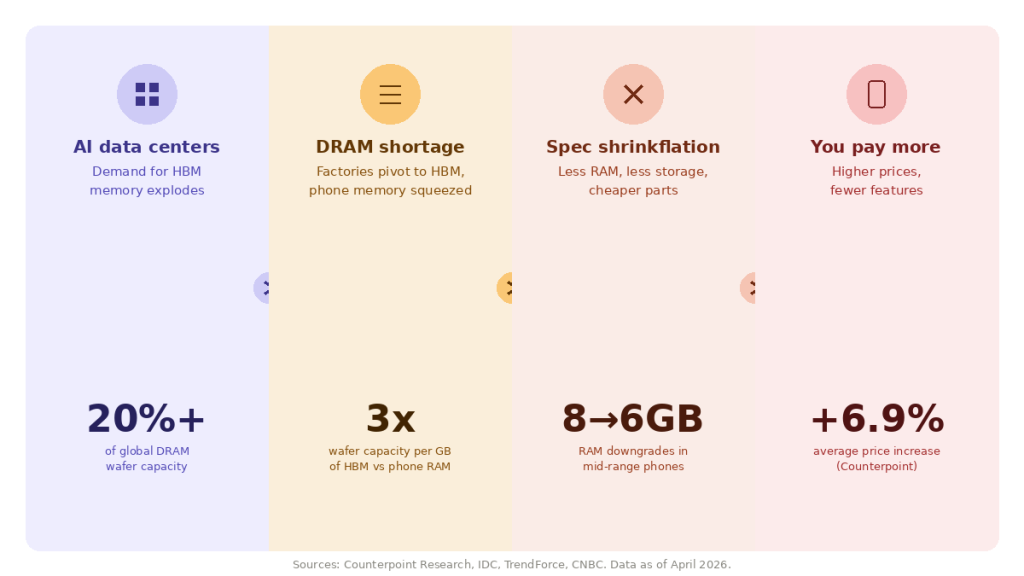
Counterpoint Research forecasts that the average selling price of smartphones will jump 6.9% in 2026, nearly double their previous forecast of 3.6%. Smartphone shipments are expected to drop 2.1%. People are paying more and buying less. And when you trace the supply chain back to the source, it starts with the same AI data centers that are raising electricity bills and drinking billions of gallons of water.
The Supply Chain, Explained Simply
Here’s the chain of events, in plain language.
AI data centers need enormous amounts of a specialized memory chip called HBM (High Bandwidth Memory). HBM is used in the Nvidia GPUs that power AI training and inference. Producing 1 GB of HBM consumes roughly three times the wafer capacity of the standard LPDDR5X memory found in your phone. That’s the same factory floor, the same raw materials, the same manufacturing equipment, just configured for a different product.
The three companies that make virtually all the world’s memory, Samsung, SK Hynix, and Micron, have been pivoting their production toward HBM because AI companies pay dramatically more for it. Every wafer allocated to an HBM stack for an Nvidia GPU is a wafer that doesn’t become LPDDR memory for your phone’s RAM or NAND flash for its storage.
IDC described this as “a potentially permanent, strategic reallocation of the world’s silicon wafer capacity.” By 2026, AI is expected to consume over 20% of global DRAM wafer capacity. The result? DRAM prices surged through late 2025 and into 2026, with TrendForce reporting sharp quarterly increases and Counterpoint warning that memory prices could rise another 40% through Q2 2026.
Phone manufacturers don’t eat those costs. They pass them to you. It’s the same dynamic we covered with AI electricity costs and water consumption – the infrastructure demands of AI ripple into everyday consumer costs.
How Much More Are You Actually Paying?
The impact varies by price tier, and the cheapest phones are getting hit hardest.
Budget phones (under $200): Bill of materials costs have risen 20-30% since the start of the shortage, according to Counterpoint. These devices have the thinnest margins, so manufacturers have almost no room to absorb the increase. Some of the price hike gets passed directly to consumers. Some gets hidden as spec downgrades (more on that below).
Mid-range phones ($200-$500): BOM costs up 10-15%. This is the segment where “spec shrinkflation” is most visible, because manufacturers protect the price tag by quietly downgrading components. IDC predicts new mid-range models will revert to 4GB or 6GB RAM configurations instead of the 8GB that became standard in 2024-2025.
Flagship phones ($600+): Higher profit margins give manufacturers more room to absorb cost increases without raising prices dramatically. Samsung’s Galaxy S26 Ultra held at $1,299. Apple is reportedly planning to keep iPhone 18 pricing stable by absorbing the margin hit. But even here, look closely at the base configurations.
Spec Shrinkflation: The Price Increase You Don’t See
This is the part that frustrates me most as someone who has owned phones from every major brand. Manufacturers have figured out that consumers notice price increases but don’t always notice spec downgrades. So instead of raising the sticker price, they quietly give you less.
Samsung Galaxy S26: The 128GB base variant was dropped entirely. The starting configuration is now 256GB at $899. No listed MSRP “increased.” The floor just moved up $100. EE Times Asia reported this tactic specifically as a margin recovery strategy.
RAM configurations: Multiple analysts and reports from IDC and TrendForce confirm that mid-range phones are reverting to lower RAM configurations. A 2025 mid-range phone with 8GB of RAM is being replaced by a 2026 model with 6GB at the same price. That’s less multitasking headroom, worse performance with demanding apps, and a shorter useful lifespan.
Storage downgrades: Isaiah Research warned that NAND shortages in H2 2026 could force second-half phone launches to ship with 256GB base storage instead of 512GB. A phone with less storage than its predecessor at the same price is a price increase wearing a spec sheet.
Component substitutions beyond memory: When memory eats a bigger share of the BOM, other components get squeezed. Camera hardware, display quality, and build materials are all in scope, according to EE Times Asia. Keep an eye on phones switching from glass backs to plastic, or dropping from AMOLED to LCD in budget tiers.
What to Expect From Specific Brands
Apple iPhone 18 (expected September 2026): Apple is reportedly planning to hold iPhone 18 prices stable despite the DRAM shortage, absorbing the cost increase through its massive supply chain leverage and services revenue. The iPhone 17e already demonstrated this: it held at $599 while doubling base storage from 128GB to 256GB. If this holds, Apple becomes the value anomaly in a market where everyone else is raising prices or cutting specs.
Samsung Galaxy S26 (launched March 2026): Already on shelves. 12GB RAM, Snapdragon 8 Elite Gen 5. Prices held nominally flat, but the elimination of the 128GB tier effectively raised the entry point. The S26 Plus absorbed $100-180 in increases across storage options. Already seeing discounts (£100 off in the UK as of mid-April), so waiting a few weeks post-launch is smart.
Google Pixel 11 (expected fall 2026): No confirmed pricing yet. Google has historically been aggressive on price-to-value ratio with the Pixel line. Whether they can maintain that in a DRAM shortage remains to be seen. The Pixel 10a, if it launches at the usual ~$499-549 price point, would be a strong mid-range pick if it avoids spec shrinkflation.
OnePlus, Nothing, Xiaomi: These brands are most exposed to the DRAM shortage because their value proposition depends on offering flagship-like specs at lower prices. Xiaomi’s CFO publicly warned that memory costs will drive up MSRPs in 2026. Leaked internal projections showed Xiaomi budgeting for a 25% increase in DRAM expense per phone. Some manufacturers are reportedly re-engineering devices to use less memory (4GB + 256GB storage instead of 8GB + 128GB) to stay under price ceilings.
Should You Buy Now, Wait, or Go Refurbished?
This is the question everyone asking “should I wait to buy a phone 2026” actually wants answered. My honest recommendation depends on your situation.
Buy now if: Your current phone is broken, dying, or genuinely unusable. The Galaxy S26 and iPhone 17e are both strong options already available. Prices on current-gen phones won’t get cheaper than they are now. DRAM costs are projected to keep rising through at least Q2 2026, which means H2 launches could cost even more.
Wait until fall 2026 if: You want the iPhone 18 and Apple delivers on the rumored price stability. Or if you can hold out for Samsung’s inevitable discounts, which tend to hit 2-3 months after launch. Galaxy S26 is already seeing price cuts in some markets.
Go refurbished if: You’re in the $200-500 range and value is your priority. Here’s the uncomfortable truth: a refurbished 2024 flagship (Galaxy S24, iPhone 15 Pro, Pixel 9 Pro) will outperform a new 2026 mid-range phone in almost every measurable way. Better display, better camera, more RAM, faster storage, premium build materials. Analysts at Asia Tech Lens noted that the spec shrinkflation in new mid-range phones is actively pushing value-conscious buyers toward the refurbished market, and that trend will only accelerate.
If I were buying a phone today in the $300-500 range, I’d look at a certified refurbished flagship from 2024 before I’d look at a new mid-range 2026 device. The specs don’t lie.
When Does This Get Better?
Most analysts don’t see meaningful relief until H1 2027 at the earliest. New DRAM fabs take years to build (Intel’s Indiana facility, SK Hynix’s Cheongju expansion), and the AI companies driving the shortage show no signs of reducing their demand. Nvidia is cutting gaming GPU output 30-40% in H1 2026 specifically to redirect memory to AI. Google plans to reach 2.8 million HBM units by 2026 per Samsung’s roadmap.
The memory shortage is structural, not cyclical. Until new manufacturing capacity comes online, phones will cost more, ship with less, or both. We’ve been tracking this across the board – from electricity bills rising 11x to memory chips disappearing from phone factories.
Frequently Asked Questions
Why are phones more expensive in 2026?
The primary driver is a global DRAM memory shortage caused by AI data centers consuming an outsized share of memory chip production. Counterpoint Research forecasts a 6.9% average selling price increase, with budget phones seeing 20-30% higher bills of materials. Manufacturers are passing these costs to consumers through higher prices and spec downgrades.
Should I wait to buy a phone in 2026?
If your phone still works, waiting for fall 2026 may get you better deals on current models through discounts. However, DRAM prices are projected to keep rising, so H2 phone launches could cost even more. Consider refurbished 2024 flagships as an alternative that delivers better specs for less money than new mid-range 2026 devices.
What is spec shrinkflation in smartphones?
It’s when manufacturers keep prices stable but quietly downgrade specifications. Examples include reducing RAM from 8GB to 6GB, eliminating lower storage tiers to raise the effective starting price, or substituting premium components with cheaper alternatives. Samsung’s Galaxy S26 dropped its 128GB tier, effectively raising the entry price by $100 without changing the listed MSRP.
Will iPhone 18 be more expensive because of AI?
Apple is reportedly planning to hold iPhone 18 prices stable by absorbing the DRAM cost increase through its supply chain scale and services revenue. If true, this would make Apple a value anomaly compared to Android competitors raising prices or cutting specs.
Is a refurbished 2024 phone better than a new 2026 mid-range phone?
In many cases, yes. A refurbished Galaxy S24, iPhone 15 Pro, or Pixel 9 Pro typically offers better display quality, camera systems, RAM, storage speed, and build materials than a new 2026 mid-range device affected by spec shrinkflation. The refurbished market is projected to grow significantly as value-conscious buyers recognize this gap.


